If you've spent any time working behind a bar, you've probably wondered whether there's a better way. The late finishes, the unpredictable rosters, the feeling of being just another employee in a busy venue—it can wear you down. But there's a growing alternative that more Australian bartenders are discovering: freelance bartending for private events.
This guide covers everything you need to know about becoming a mobile bartender in Sydney or Melbourne. Whether you're looking to make a complete career shift or just want to pick up extra work on weekends, we'll walk through the practical steps to get you started—and thriving—in the private events market.
What is Freelance Bartending?
Freelance bartending—sometimes called mobile bartending or private event bartending—means working directly with clients rather than being employed by a venue. Instead of pulling shifts at a bar or restaurant, you book individual events: weddings, corporate functions, birthday parties, engagement celebrations, product launches, and more.
You're essentially running your own small business. You set your rates, choose which bookings to accept, and manage your own schedule. Some freelance bartenders work events as a side hustle alongside venue shifts, while others go fully independent and build their entire income from private bookings.
The Difference from Agency Work
You might be thinking: "But I can already pick up casual shifts through staffing agencies." True—but there's a crucial difference. When you work through an agency, they typically pay you $30-40/hour while charging the client $60-80/hour. The agency pockets the difference.
When you book directly with clients, you keep the full rate. A four-hour wedding gig at $65/hour puts $260 in your pocket instead of $140. That difference adds up quickly over a year of events.
Why Freelance Bartending Beats Venue Work
Beyond the money, there are compelling reasons why bartenders are making the switch:
- Flexibility: You choose when you work. No more being rostered on for Sunday brunch when you wanted to visit family. Accept the bookings that suit your life.
- Better pay: Direct bookings mean no agency or venue taking a cut. Most freelance bartenders earn 30-50% more per hour than their venue counterparts.
- Variety: Instead of the same bar every shift, you're working different locations, meeting different people, experiencing different events. A harbour-side wedding one weekend, a warehouse corporate party the next.
- Professional growth: You develop business skills alongside bartending skills—client communication, marketing, pricing, time management.
- Better clients: People hiring bartenders for private events are excited about their celebration. You're part of their special day, not just another transaction at a busy bar.
- Earlier finishes: Most private events wrap up by 11pm or midnight, meaning you're home at a reasonable hour instead of closing a venue at 3am.
Requirements to Get Started
Before you take your first booking, you'll need a few things in place. Let's break down each requirement.
RSA Certification
This one's non-negotiable. In Australia, anyone serving alcohol commercially must hold a valid Responsible Service of Alcohol (RSA) certificate for their state. NSW and Victoria have different RSA requirements, so if you plan to work across both states, you'll need both certificates.
How to get your RSA:
- NSW: Complete an approved RSA course (available online or in-person). Courses cost $70-150 and take 6-8 hours. Once you pass, your competency card is valid for 5 years. Providers include TAFE NSW, CFT Training, and various online platforms.
- Victoria: Similarly, complete a Victorian RSA course through an approved provider. Costs are comparable at $50-120, and certification lasts 3 years.
If your RSA is expiring soon, renew it before it lapses. An expired RSA means you can't legally work any event—don't let this catch you out.
ABN Setup
As a freelance bartender, you're running a small business. You'll need an Australian Business Number (ABN) to invoice clients and operate legally.
Good news: ABN registration is free and takes about 10 minutes online at abr.gov.au. You'll need to decide on a business structure—most solo bartenders register as a 'sole trader', which is the simplest option.
Once you have your ABN, you can issue proper invoices and keep your business income separate from personal earnings. This also makes tax time much easier—you can claim legitimate business expenses like equipment, insurance, travel, and even a portion of your phone bill.
Public Liability Insurance
This is where many new freelancers get confused. Public liability insurance protects you if something goes wrong at an event—for example, if a guest trips over your bar equipment and gets injured.
Do you need it? Technically, it's not legally required. But practically, many clients (especially corporate clients and venues) will require you to have it before confirming a booking. Weddings at private properties are more flexible, but the risk is still yours.
What it costs: Basic public liability cover ($10-20 million) for a freelance bartender typically runs $300-600 per year through providers like BizCover, Aon, or specialist hospitality insurers. That's roughly the profit from one or two events—a worthwhile investment for peace of mind and access to better bookings.
Keep a copy of your certificate of currency ready to send clients who request it.
Equipment Checklist
What you need depends on your service model. Some bartenders offer 'labour only' (they show up, the client provides everything else), while others bring a complete mobile bar setup.
Essential bar tools (minimum kit):
- Boston shaker set
- Jiggers (25ml and 50ml)
- Bar spoon
- Hawthorne strainer
- Muddler
- Citrus press
- Bottle opener and wine key
- Chopping board and sharp knife
- Bar towels (bring more than you think you'll need)
For a mobile bar service:
- Portable bar or counter (folding tables work to start)
- Ice bins or eskies
- Speed rails or bottle holders
- Glassware (or quality plastic alternatives)
- LED lighting or bar backdrop
- Transport solution (a station wagon or small van helps)
Start with the essentials and upgrade as bookings increase. A good set of bar tools costs $100-200; a full mobile bar setup can run $1,000-5,000 depending on how polished you want it to look.
Setting Your Rates
Pricing is where many new freelancers struggle. Charge too little and you undervalue yourself (and undercut the market). Charge too much too soon and you won't get bookings. Here's how to think about it.
Market Rates in Sydney vs Melbourne
The Sydney and Melbourne markets are roughly comparable, though Sydney tends to sit slightly higher due to cost of living.
Current market rates (2026):
- Entry-level (1-2 years experience): $45-55/hour
- Mid-level (3-5 years experience): $55-70/hour
- Senior/specialist (5+ years or unique skills): $70-90/hour
These rates are for the bartender's time only. If you're providing equipment, glassware, or a mobile bar setup, you should charge additional fees or a package rate.
Pricing for Different Event Types
Not all events are equal. Wedding clients expect to pay more than someone hosting a backyard 30th. Here's a rough guide:
- House parties and birthdays: Standard hourly rate, often 4-6 hour bookings
- Engagement parties: Standard to slightly premium rates
- Weddings: Premium rates (10-20% above standard). These require more prep, coordination, and sometimes longer hours
- Corporate events: Premium rates, but often shorter bookings (2-4 hours). May require invoice terms rather than immediate payment
- Festival or public events: Can be lower hourly but longer shifts; factor in fatigue and conditions
Valuing Your Experience
If you've got a decade behind the bar, don't charge the same as someone who just finished their RSA. Your experience means fewer mistakes, better drinks, smoother service, and a more relaxed client. That's worth money.
Conversely, if you're just starting out, don't pretend to be an expert. Be honest about your experience level, charge fair entry rates, and let your work speak for itself. Building a reputation takes time.
Additional Charges
Travel: For events outside your usual service area (say, more than 30km from your home), charge for travel. Either a flat call-out fee ($30-50) or per-kilometre rate (70-80c/km) is standard.
Equipment: If you're bringing a mobile bar setup, charge a separate equipment fee ($100-300 depending on what's included) rather than rolling it into your hourly rate.
Minimum booking: Consider setting a minimum booking of 3-4 hours. By the time you travel, set up, work, pack down, and travel home, a 2-hour booking barely makes financial sense.
Peak periods: December-January wedding season, New Year's Eve, and other peak dates can command premium rates. You're in demand—price accordingly.
Building Your Profile and Brand
In the freelance world, your profile is your storefront. Clients are choosing between multiple bartenders—give them reasons to choose you.
Professional Photos
First impressions matter. A grainy selfie won't cut it. You need at least one high-quality photo that shows you looking professional and approachable behind a bar.
Options include:
- Hiring a photographer for a quick session (many do 30-minute sessions for $150-250)
- Asking a friend with a decent camera to take shots at your next event
- Using your phone's portrait mode in good lighting—natural daylight works well
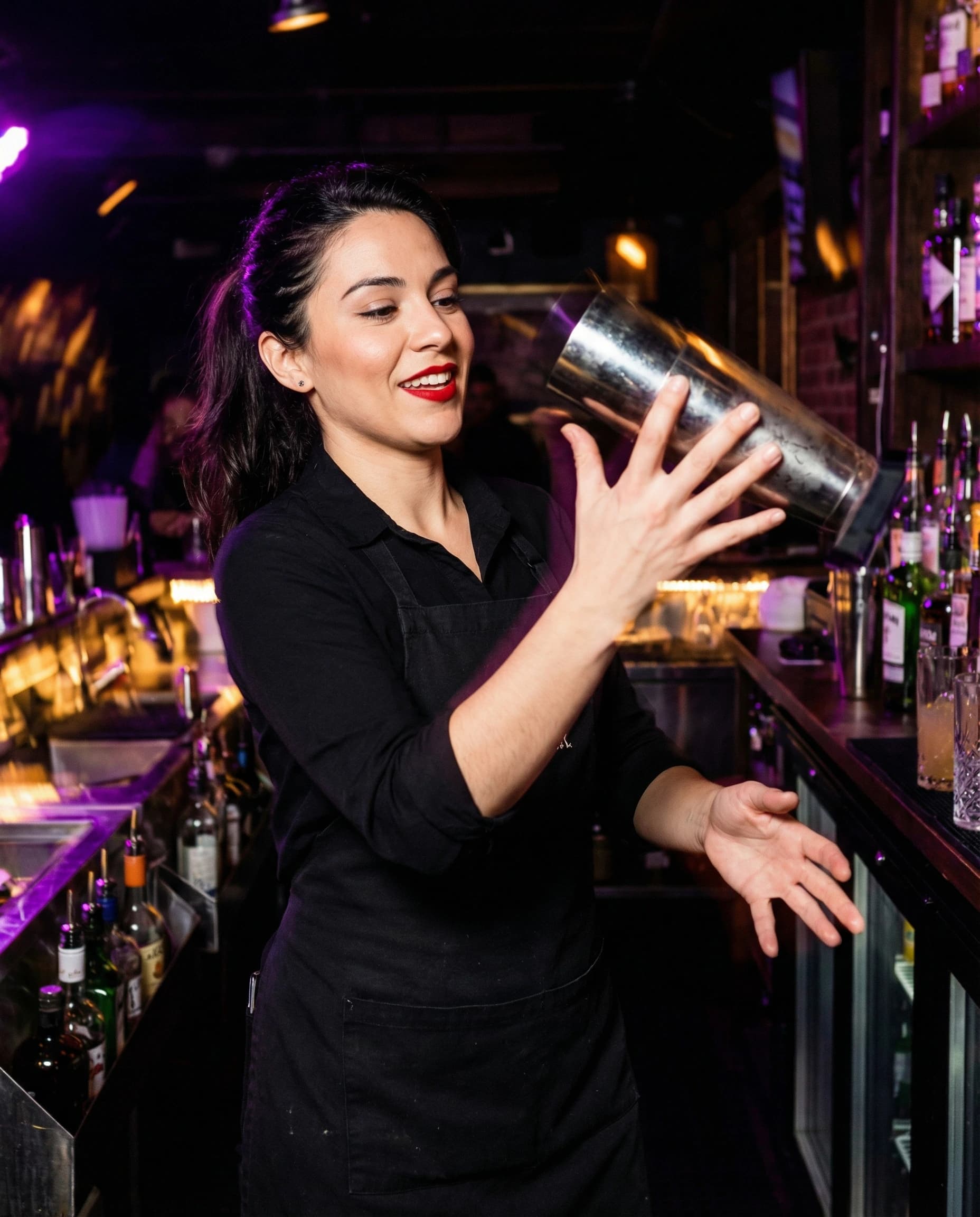
Dress the part: black shirt, neat appearance, action shots (shaking a cocktail, pouring a drink) work better than static poses.
Writing Your Bio
Your bio should cover who you are, what you bring to events, and why clients should book you. Keep it genuine—personality matters in this industry.
Include:
- Your bartending experience (years, venues, event types)
- Your specialties (craft cocktails, wine expertise, high-volume service, flair)
- What makes you different (signature cocktails, specific training, personality traits)
- Your approach to events (reliable, friendly, professional—whatever genuinely describes you)
Avoid:
- Generic fluff that could describe anyone
- Exaggerating your experience (clients will notice)
- Walls of text—be concise
Showcasing Specialties
If you've got skills beyond standard service, highlight them. Can you create custom cocktail menus for events? Do you specialise in whisky, natural wine, or tiki drinks? Have you worked with well-known venues or bartenders?
Specific credentials stand out: "Certified sommelier with 5 years at top Sydney wine bars" is more compelling than "experienced with wine."
Getting Your First Bookings
You've got your RSA, your ABN, your equipment. Now how do you actually find clients?
Platforms to List On
Bartender booking platforms connect you directly with hosts looking for event staff. Hire Bartender is built specifically for the Australian market, letting you create a profile, set your rates, and receive booking requests from hosts in Sydney and Melbourne.
The advantage of platforms is visibility—hosts are actively searching for bartenders. You don't need to chase clients; they find you. Most platforms allow you to showcase your experience, set your availability, and manage bookings in one place.
Other channels to explore:
- Word of mouth: Tell friends, family, and current colleagues that you're available for private events. Personal referrals often lead to the best bookings.
- Social media: Instagram works well for bartenders—post photos from events (with permission), cocktail creations, and behind-the-scenes content. Use location tags and relevant hashtags.
- Google Business Profile: If you're building a proper mobile bar business, set up a Google Business listing to appear in local searches.
Networking Strategies
The events industry runs on relationships. Connect with:
- Event planners and coordinators: They book bartenders regularly and can become ongoing sources of work
- Wedding vendors: Photographers, florists, celebrants—they get asked for recommendations and can refer clients your way
- Venue managers: Some venues allow or require external bartenders for private hires
- Other bartenders: When someone can't take a booking, they might pass it to you (and vice versa)
Getting Reviews
Reviews build credibility. After your first few events, politely ask clients if they'd be willing to leave a review. Most happy clients are glad to help—they just need the prompt.
Make it easy: send them a direct link to your profile, and thank them genuinely for their feedback.
On-the-Job Tips
Landing the booking is step one. Delivering an excellent experience is how you build a sustainable business.
Preparing for Events
A week before:
- Confirm all details with the client: timing, address, parking, what they're providing
- Finalise the drink menu and check you have all required ingredients
- Review any special requests or dietary requirements
The day before:
- Pack equipment and check nothing's missing
- Prep any garnishes that can be done ahead
- Confirm you have client contact details readily accessible
Day of:
- Arrive at least 30-45 minutes before service starts
- Set up efficiently, introduce yourself to the host
- Check ice, glassware, and drink stock before guests arrive
Client Communication
Clear communication prevents problems. Respond to enquiries within 24 hours (faster is better). Be specific about what's included in your service and what's not. Confirm details in writing—a simple email recap protects both parties.
During the event, check in with the host at key moments. After the event, send a brief thank-you message. These small touches build lasting relationships.
What to Wear
Unless the client specifies otherwise, the standard uniform is:
- Black button-up shirt or smart black polo
- Black pants or smart dark jeans
- Closed-toe black shoes (comfortable—you'll be standing for hours)
- Neat, clean appearance overall
Some events have dress codes or themes—ask in advance if unsure.
Handling Difficult Situations
It happens: a guest drinks too much, a supplier doesn't show up, equipment breaks. Your job is to stay calm and solve problems quietly.
- Intoxicated guests: Your RSA training covers this. Stop serving them, offer water, and if necessary, involve the host discretely.
- Running low on supplies: Flag it early to the host. It's better to slow service slightly than run out completely.
- Client disagreements: Stay professional. If there's a dispute about what was agreed, refer back to your written confirmation.
Most events run smoothly. When they don't, your professionalism under pressure is what clients remember.
Growing Your Business
Once you've done a few events, think about scaling sustainably.
Building Repeat Clients
A client who books you once can book you many times. Corporate clients especially often have regular events—monthly functions, quarterly parties, annual celebrations. Stay in touch, send a message before peak seasons offering your availability, and make rebooking easy.
Getting Referrals
Ask satisfied clients to recommend you to friends. Better yet, make it specific: "If you know anyone getting married or planning a big party, I'd love the referral." Word of mouth is still the most powerful marketing in this industry.
Scaling Up
As your bookings increase, you might need help. Some bartenders build small teams, taking larger events or multiple bookings on the same day. If you go this route:
- Only work with bartenders you trust and have seen in action
- Be clear about your standards and expectations
- Consider the legal and insurance implications of hiring others
Scaling is optional. Many successful freelance bartenders prefer staying solo—fewer headaches, full control, and all the profits stay with you.
Getting Started Today
Breaking into freelance bartending isn't complicated, but it does require taking action. Here's your quick-start checklist:
- Confirm your RSA is current (renew if needed)
- Register for an ABN if you don't have one
- Consider public liability insurance
- Gather your essential bar equipment
- Get a professional photo taken
- Write a compelling bio
- Create your profile on Hire Bartender
- Set your availability and rates
- Start accepting bookings
The private events market is growing, and there's room for quality bartenders who deliver great experiences. Whether you're looking to leave venue work behind entirely or just want to earn better money on weekends, freelance bartending offers a path to more flexibility, more income, and more enjoyable work.
Your first booking will feel like a leap. After a few events, it becomes second nature. And once you've experienced the freedom of being your own boss, it's hard to go back.
Ready to take the first step? Learn more about joining Hire Bartender and start connecting with hosts looking for exactly what you offer.
Written by Hire Bartender Team · Editorial